Is honey fructose or glucose?
Both. Codex describes honey as predominantly fructose and glucose. A typical jar has more fructose than glucose, but not only one sugar. The fructose-to-glucose ratio, F/G, is fructose mass divided by glucose mass.
USDA FoodData Central record 169640 is a general honey reference, not a variety table. Variety numbers below are literature typical means used elsewhere on this site. They are not HPLC results for a named harvest.
Pro Tip
F/G above 1 means more fructose than glucose in that typical mean. F/G below 1 means more glucose. A real jar can sit off the mean.
What the numbers are
The chart uses the same 17 typical-mean rows as the learn F/G guide: White (1975) and Doner (1977) for several North American uniflorals, Persano Oddo & Piro 2004 for European uniflorals, and Bogdanov and colleagues for later composition surveys. Fructose and glucose in those rows are percent of jar mass.
Treat each row as a working mean. The learn page states the usual bound: about ±2 percentage points on fructose and glucose in an individual jar, with F/G more stable (about ±0.1 within a variety). That is a stated range, not a new measurement.
- Tupelo typical mean — 44.5% fructose, 26.9% glucose, F/G about 1.65.
- Acacia (Robinia) typical mean — 41.0% / 28.0%, F/G about 1.46.
- Clover typical mean — 38.2% / 36.1%, F/G about 1.06.
- Lavender typical mean — 36.5% / 37.6%, F/G about 0.97.
- Rapeseed/canola typical mean in this table — 39.0% / 39.0%, F/G 1.00. This page does not repeat an unsourced 0.77 canola figure.
Get the Honey Buyer's Cheat Sheet (free PDF)
16 varieties on one page — color, flavor, best use and what a fair price looks like — from the 304 honeys we track.
Why people care: crystallization, not a health score
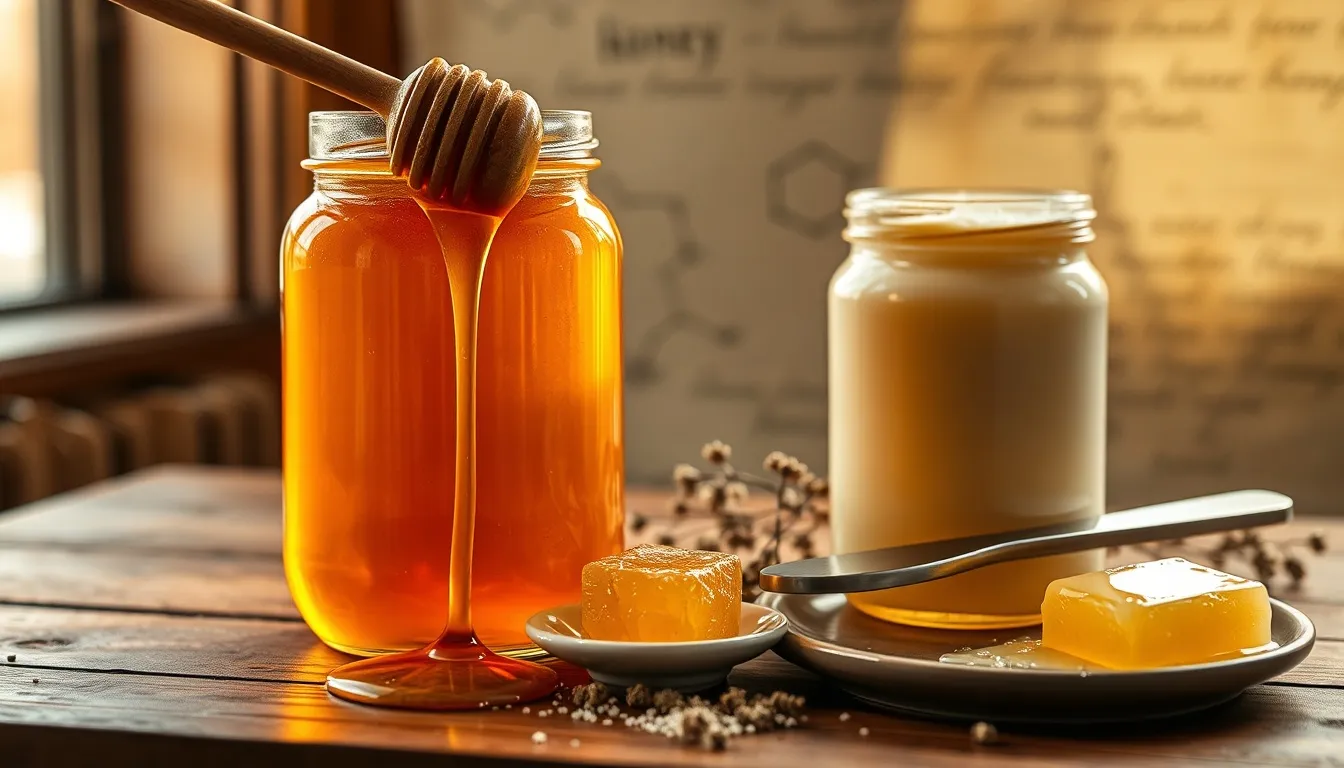
Glucose crystallizes from honey more readily than fructose. Varieties whose typical mean is fructose-forward often stay pourable longer; glucose-forward means often set sooner. Temperature, moisture, and seed crystals still matter. Heather is a known exception: its gel is not the same as glucose crystals.
This article does not rank honeys for blood sugar, diabetes, or adulteration screening. F/G is composition. Codex CXS 12-1981 sets product composition boundaries; it does not turn a ratio into a medical or forensic verdict.
How to use the ratio in the kitchen
If you want honey that stays liquid in a squeeze bottle, start with high-F/G typical means such as tupelo or acacia, and still expect batch variation. If you want a set or creamed texture, a glucose-forward typical mean is the usual starting point.
For baking substitutions, use the honey-in-baking guide. Do not treat F/G as a calorie or carbohydrate override. The nutrition facts page is the USDA reference for calories and sugars.