Honey for Sleep
Taking honey before bed is a centuries-old sleep remedy that emerging science is starting to explain. Learn how honey affects melatonin production, which types work best, and the most effective bedtime routines.
Last updated:
Honey before bed may support sleep through a proposed mechanism: restocking liver glycogen and triggering a metabolic chain where glucose causes a mild insulin spike that helps tryptophan enter the brain, where it converts to serotonin and then melatonin. Some people include raw honey before bed — straight or in warm milk or chamomile tea — though there's no clinically established dose. Evidence for honey specifically is still limited — talk to a doctor if you have ongoing sleep problems.

How Honey May Improve Sleep
The relationship between honey and sleep involves several interconnected biological mechanisms. The most widely discussed theory centers on honey's ability to restock liver glycogen. During sleep, the brain relies heavily on liver glycogen for fuel. When liver glycogen stores run low — as can happen after an evening without adequate carbohydrate intake — the body triggers a stress response, releasing cortisol and adrenaline to mobilize energy from other sources. This stress response can cause nighttime waking and restless sleep. Honey, with its roughly 1:1 ratio of fructose to glucose, is uniquely efficient at replenishing liver glycogen because fructose is preferentially taken up by the liver — acacia honey is especially efficient with its higher fructose content, while buckwheat honey provides additional antioxidants for overnight cellular recovery. Additionally, the glucose in honey causes a mild insulin spike, which allows tryptophan (an amino acid) to cross the blood-brain barrier more easily. Tryptophan is the precursor to serotonin, which the pineal gland then converts to melatonin — the hormone that regulates the sleep-wake cycle. This chain reaction, from honey to insulin to tryptophan to serotonin to melatonin, provides a natural mechanism for promoting drowsiness. Honey also contains trace amounts of tryptophan itself, as well as small quantities of other sleep-supportive compounds including potassium and magnesium, both of which promote muscle relaxation.
Key Takeaways
- Restocks liver glycogen, preventing the stress hormones that cause nighttime waking
- Fructose-glucose ratio is uniquely efficient for liver glycogen replenishment
- Mild insulin spike helps tryptophan cross the blood-brain barrier
- Tryptophan converts to serotonin, then to melatonin (the sleep hormone)
- Contains trace tryptophan, potassium, and magnesium for relaxation
- May reduce cortisol and adrenaline release during overnight fasting
The Science Behind Honey and Sleep
The scientific evidence for honey as a sleep aid is growing but still in early stages. Much of the foundational theory comes from pharmacist Mike McInnes, who detailed the liver glycogen-sleep connection in his research. While the underlying biochemistry of tryptophan metabolism and melatonin synthesis is well established, large-scale clinical trials specifically testing honey for sleep improvement are limited. A 2014 study in the International Journal of Food Sciences found that honey consumption before bed was associated with improved sleep quality in a small cohort, though the study size was modest. More robust evidence exists for honey's effect on nighttime cough, which indirectly improves sleep. The landmark Penn State study and the 2020 BMJ Evidence-Based Medicine systematic review both documented significant improvements in sleep quality among participants whose cough was treated with honey, compared to those receiving OTC medications or no treatment. A 2019 Malaysian study on Tualang honey found improved sleep quality scores in postmenopausal women over an 8-week period. The glycemic index of honey varies by variety — acacia honey (~32) is low-GI while common clover honey (~69) is near table sugar (65). Regardless of variety, the high fructose content in honey is preferentially metabolized by the liver, which may support liver glycogen replenishment and more stable overnight blood sugar compared to rapidly-absorbed glucose sources.
Key Takeaways
- Liver glycogen-sleep theory is based on established biochemistry
- Dedicated large-scale sleep trials are still limited
- 2014 study associated bedtime honey with improved sleep quality
- Strong evidence for improved sleep via nighttime cough reduction
- Tualang honey improved sleep quality scores in postmenopausal women over 8 weeks
- High fructose content supports liver glycogen replenishment; low-GI varieties (acacia honey ~32) minimize late-night blood sugar spikes
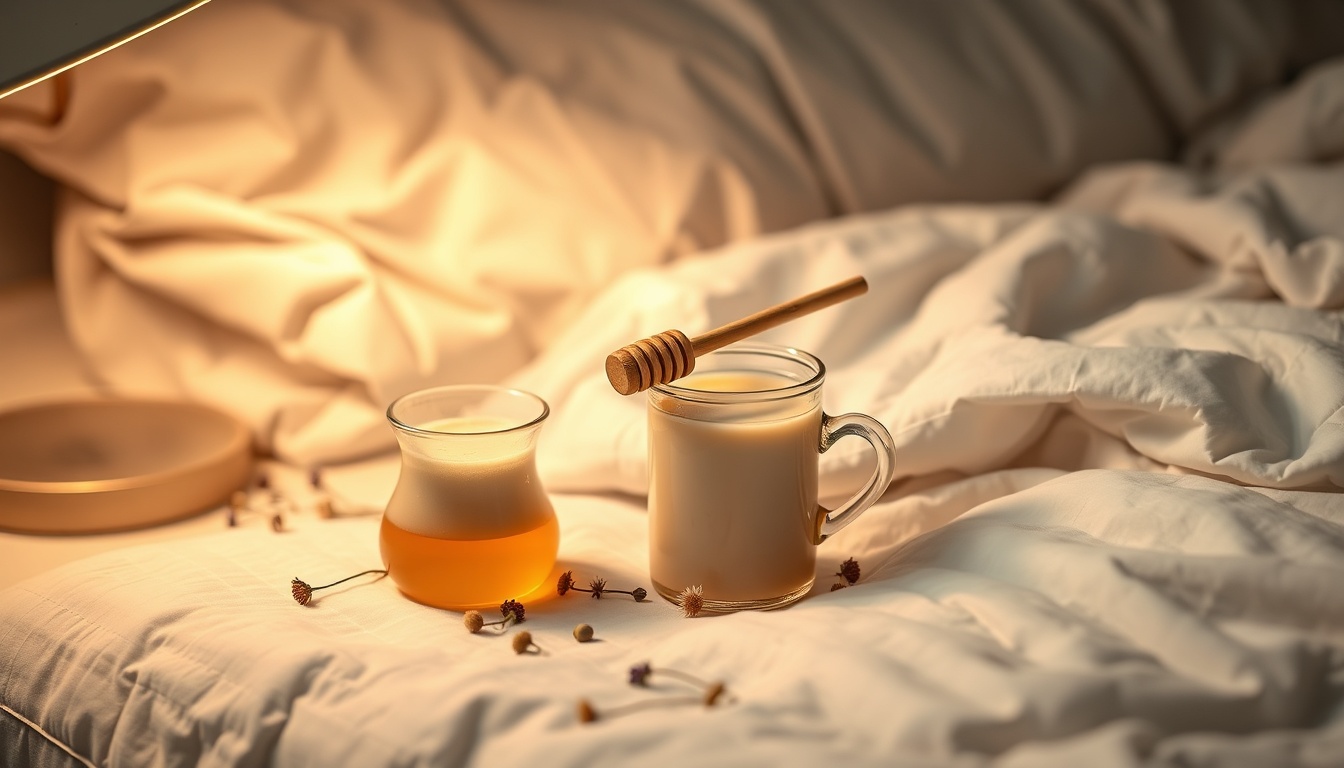
Best Ways to Take Honey Before Bed
There is no clinically established dose or timing. Some people include raw honey in a bedtime wind-down routine, either straight or dissolved in a small amount of warm water — the idea being to give the proposed metabolic cascade (glycogen replenishment, insulin response, tryptophan transport) time to unfold before lying down. Warm honey milk is a time-honored sleep remedy that combines the tryptophan-boosting effects of honey with milk's own tryptophan content. Heat one cup of milk (dairy or fortified plant-based) to a warm drinking temperature and stir in one tablespoon of honey — acacia honey works particularly well here due to its mild flavor and optimal liver glycogen efficiency. Golden milk is an enhanced version: warm milk with honey, a pinch of turmeric, a small pinch of black pepper, and optionally a dash of cinnamon. The turmeric adds anti-inflammatory curcumin while cinnamon helps regulate blood sugar. Honey-chamomile tea is another excellent option — chamomile contains apigenin, a compound that binds to GABA receptors in the brain and promotes relaxation. Steep chamomile tea for five minutes, let it cool slightly, then stir in a tablespoon of linden honey for traditional calming benefits or wildflower honey for diverse sleep-supporting compounds. Avoid adding honey to boiling liquids, as temperatures above 140 degrees F degrade beneficial enzymes. Do not eat a large meal close to bedtime alongside the honey, as heavy digestion can itself disrupt sleep.
Key Takeaways
- Some people include raw honey as part of a bedtime wind-down routine, though there is no clinically established dose or timing
- Warm honey milk: combines honey's insulin effect with milk's tryptophan
- Golden milk: add turmeric and cinnamon to honey milk for enhanced benefits
- Honey-chamomile tea: chamomile's apigenin promotes relaxation alongside honey
- Never add honey to boiling liquids — keep water below 140 degrees F
- Avoid large meals alongside bedtime honey — heavy digestion disrupts sleep

Best Honey Types for Sleep
For sleep purposes, the most important characteristic is that the honey be raw and unfiltered, as processing destroys the enzymes and trace nutrients that contribute to honey's metabolic effects. Among specific varieties, raw wildflower honey is an excellent general choice with a diverse nutrient profile and pleasant flavor that pairs well with warm beverages. Linden honey (basswood) has been traditionally used as a calming remedy in European folk medicine and has a mild, slightly floral flavor that many find pleasant before bed. Buckwheat honey, with its robust dark color and strong molasses-like flavor, has the highest antioxidant content among common honeys and may provide additional anti-inflammatory benefits that support restful sleep. Acacia honey is the mildest in flavor and has a higher fructose-to-glucose ratio, which means it is particularly efficient at replenishing liver glycogen — the central mechanism in the honey-sleep theory. Manuka honey, while excellent for therapeutic purposes, is not necessarily superior to other raw honeys specifically for sleep, and its higher cost may not be justified for this particular use case. The key is consistency — use whichever raw honey you enjoy most and can sustain as a nightly routine.
Key Takeaways
- Raw and unfiltered is essential — processing destroys key enzymes and nutrients
- Wildflower honey: excellent all-around choice with diverse nutrient profile
- Linden honey: traditionally used as a calming remedy in European folk medicine
- Buckwheat honey: highest antioxidant content, strong flavor
- Acacia honey: highest fructose-to-glucose ratio, most efficient for liver glycogen
- Manuka honey not necessarily superior for sleep — use whichever raw honey you prefer
Tips and Caveats
While honey is a safe and gentle sleep aid for most adults, several considerations are important. People with diabetes should account for the carbohydrate content — one tablespoon of honey contains approximately 17 grams of carbs and will affect blood sugar. The potential sleep benefits need to be weighed against glycemic impact, and consulting a healthcare provider is recommended. Honey is not a treatment for clinical insomnia. If you regularly take more than 30 minutes to fall asleep, wake frequently during the night, or feel unrefreshed after adequate sleep duration, speak with a healthcare provider about possible sleep disorders. Honey should be seen as part of good sleep hygiene, not a standalone solution. Other sleep hygiene practices — consistent bedtime, cool dark room, limiting screens before bed, avoiding caffeine after noon — will have a larger impact on sleep quality than honey alone. Never give honey to infants under 12 months due to infant botulism risk. For older children, talk to your pediatrician about appropriate amounts. The caloric content of honey (about 64 calories per tablespoon) is modest, but if you are managing your weight, factor it into your daily intake. Dental hygiene is also worth noting — brush your teeth after consuming honey before bed to prevent cavity formation from the natural sugars.
Key Takeaways
- Diabetics: account for ~17g carbs per tablespoon, consult healthcare provider
- Not a treatment for clinical insomnia — see a doctor for persistent sleep issues
- Best as part of overall sleep hygiene, not a standalone solution
- NEVER give honey to infants under 12 months
- For children over 1, talk to your pediatrician about appropriate amounts
- Brush teeth after consuming honey before bed to protect dental health
Frequently Asked Questions
Can honey help you sleep better?
Honey may improve sleep by restocking liver glycogen, which prevents the stress hormone release that causes nighttime waking. It also triggers a chain reaction that promotes natural melatonin production.
How does honey promote sleep?
Honey causes a mild insulin spike that helps tryptophan cross the blood-brain barrier. Tryptophan converts to serotonin and then melatonin, the hormone that regulates your sleep-wake cycle.
When should you take honey before bed?
There is no clinically established dose or timing. Some people include raw honey — straight, or stirred into warm water, chamomile tea, or warm milk — as part of a bedtime wind-down routine.
What is the best type of honey for sleep?
Any raw, unfiltered honey works well for sleep. Acacia honey is particularly efficient at replenishing liver glycogen due to its high fructose-to-glucose ratio, while linden honey has a traditional reputation as a calming remedy. Wildflower honey offers a balanced nutrient profile, and buckwheat honey provides maximum antioxidants for anti-inflammatory sleep support.
Edited by Sam French · Raw Honey Guide Editorial Team
Source reviewed against primary literature and official guidance where available. Health content is educational, not medical advice, and does not replace a licensed clinician.
Get the Honey Buyer's Cheat Sheet (free PDF)
16 varieties on one page — color, flavor, best use and what a fair price looks like — from the 304 honeys we track.
Related Guides
Honey and Milk
Warm milk and honey for sleep, recipes, and benefits.
Read GuideHealth Benefits
Nutritional and therapeutic benefits of honey.
Read GuideHoney & Cinnamon Benefits
What science says about this combination.
Read GuideRelated Articles
Honey Before Bed: Can It Really Help You Sleep?
Can honey before bed improve sleep? The science on liver glycogen, melatonin pathways, best types, and safety notes.
Read ArticleBest Time to Eat Honey: Morning, Night, Before Meals, and More
Best times to eat honey: morning, before bed, pre-workout, and when sick. Science-backed timing guide by health goal.
Read ArticleHoney and Milk: A Simple Warm Drink, Evidence and Safety
Drinking warm milk with honey at night: a 1-cup recipe with 1–2 tsp honey, what the 105-child cough trial showed, what is unproven for sleep, and dairy swaps.
Read ArticleReady to try honey as part of your bedtime routine?
Browse Raw Honey for Better Sleep