A 304-Listing Window Into the World's Honey Geography
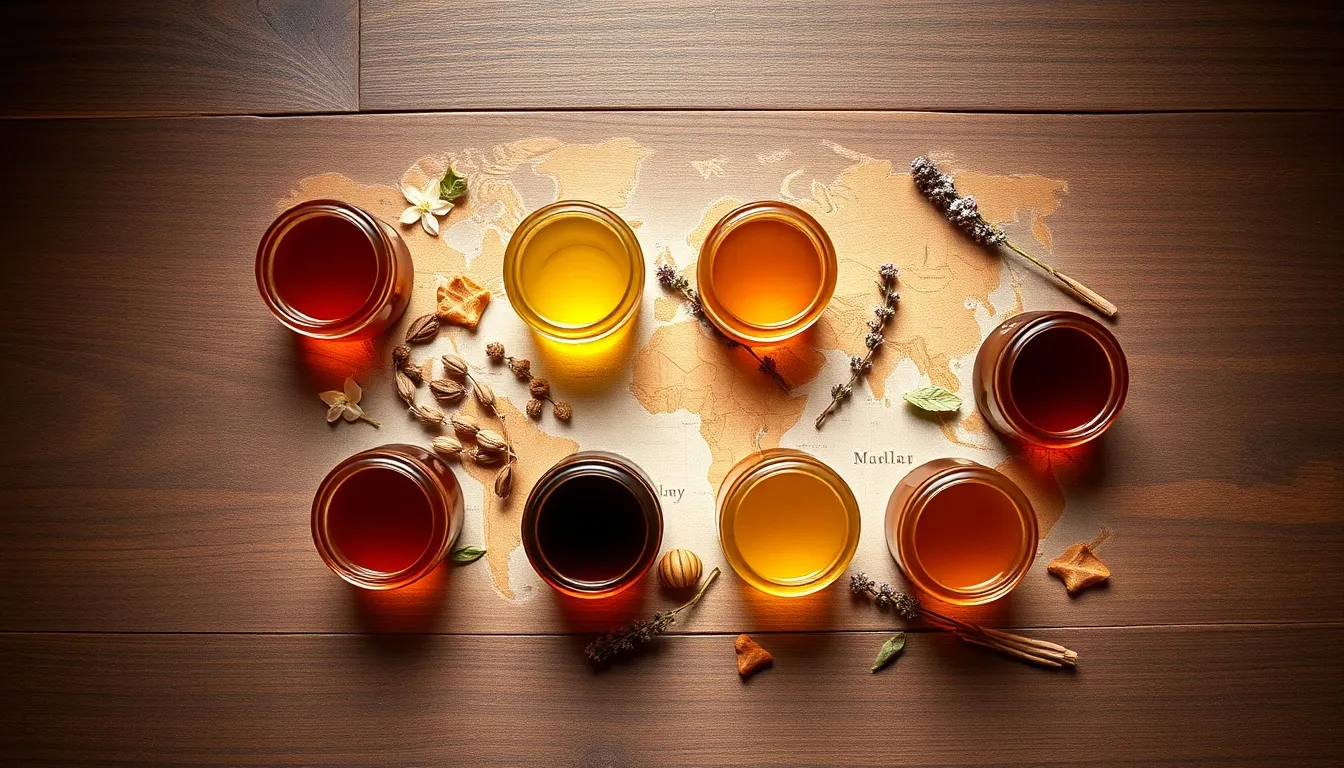
The Raw Honey Guide catalog contains 304 honeys from 15 named producing countries, plus 35 listings from 28 more countries grouped as "Other". Every listing was checked against a live product page on October 7, 2026. When you map those listings against their origin countries and floral sources at the same time, the honey market stops looking like a commodity grid and starts looking like an ecological atlas.
Each cell in that matrix — a country paired with a flower — represents a convergence of climate, soil, bee species, and husbandry. Some cells hold a dozen listings. Others are empty. The empty cells are as informative as the full ones: they tell you which flowers only bloom where, and which climates cannot produce a given honey at all.
This analysis maps the 304 listings by origin and floral source, surfaces the patterns, and builds toward a practical conclusion: origin is not just a provenance story. It is a quality signal, a fraud detection tool, and a predictor of flavor before you open a jar.
The Origin Distribution: 15 Named Countries, One Dominant Producer
The United States accounts for 134 of 304 listings — 44.1% of the catalog. No other country comes close. The "Other" group is next with 35 listings from 28 countries (Romania, Portugal, Poland, Yemen, Malaysia and others), then New Zealand with 28 (9.2%), Australia (17), Italy (12), Spain (10), France (10), Canada (9) and Greece (9). The remaining seven named countries — Brazil, the UK, Mexico, Germany, Hungary, Turkey and Argentina — account for 40 listings (13.2%).
This distribution is not simply a reflection of production volume. China produces roughly 500,000 metric tonnes of honey per year — more than four times any other country — yet has no listing in the catalog. Argentina is one of the world's largest honey exporters by volume yet contributes three listings. The catalog tracks monofloral variety and producers who sell online, not tonnage.
The USA's lead reflects something specific to North America: the geographic spread to support many distinct floral ecosystems, from Appalachian forest to Florida swamps to California sage scrub to Upper Midwest clover. No other single country in the catalog has that spread within its borders.
- USA: 134 listings — WILDFLOWER (16), CLOVER (12), SOURWOOD (12), ORANGE BLOSSOM (8), TUPELO (8), SAGE (7), AVOCADO (6), BLUEBERRY (6), BUCKWHEAT (6), LINDEN (4), ACACIA (2), eucalyptus (1), lavender (1), other/specialty (45)
- New Zealand: 28 listings — MANUKA (16, 57% of NZ listings), clover (1), native-forest and other specialty honeys (11)
- Australia: 17 listings — EUCALYPTUS (12, 71% of AU listings), manuka (1), lavender (1), wildflower (1), other (2)
- Italy: 12 listings — CHESTNUT (3), ACACIA (2), LAVENDER, orange blossom, WILDFLOWER, other (4, including sulla and strawberry-tree honey)
- Spain: 10 listings — ORANGE BLOSSOM, LAVENDER, HEATHER, CHESTNUT, eucalyptus, acacia, wildflower, other (3)
- France: 10 listings — LAVENDER (4), BUCKWHEAT, CHESTNUT, LINDEN, acacia, wildflower, other (1)
- Canada: 9 listings — CLOVER (2), BUCKWHEAT (2), blueberry, LINDEN, other (3)
- Greece: 9 listings — thyme, pine, fir and strawberry-tree honeys (5), acacia, CHESTNUT, orange blossom, wildflower
- UK: 7 listings — HEATHER (5), other (2)
- Hungary: 5 listings — ACACIA (robinia), LINDEN, wildflower, sunflower, forest honeydew
Get the Honey Buyer's Cheat Sheet (free PDF)
16 varieties on one page — color, flavor, best use and what a fair price looks like — from the 304 honeys we track.
The Geographic Lock: Three American Varieties That Cannot Be Replicated Elsewhere
Within the USA's 134 listings, three floral sources stand out as uniquely American in a botanically strict sense: Sourwood, Tupelo, and (within the catalog) Sage. Each is tied to a specific ecosystem that does not exist at commercial scale on any other continent.
Sourwood honey (Oxydendrum arboreum) comes from a single flowering tree native to the southern Appalachians — primarily western North Carolina, north Georgia, east Tennessee, southwest Virginia and West Virginia. Sourwood trees need the elevation band, humidity, and acidic soil of Appalachian hardwood forest. The honey has a distinctive anise-caramel-butterscotch flavor that no other flower reproduces. Honey labeled "Sourwood" from outside this region is, botanically speaking, impossible to authenticate. All 12 Sourwood listings in the catalog come from this region.
Tupelo honey (Nyssa ogeche) is similarly locked to the riverine swamps of the Florida Panhandle and south Georgia, where the Ogeechee tupelo blooms for two to three weeks each April over standing water. Beekeepers move hives in for the bloom and out again before other flowers open, to keep the honey monofloral. Tupelo honey has a high fructose-to-glucose ratio, so it crystallizes very slowly. All 8 Tupelo listings in the catalog come from Florida or Georgia; each can be verified by pollen analysis.
Sage honey (Salvia spp.) comes primarily from California coastal sage scrub — a shrubland dominated by Salvia mellifera (black sage) and Salvia apiana (white sage) in a narrow Pacific coastal strip from Baja California into central California. The flavor is mild, clear, slow to crystallize, and lightly herbal. All 7 sage listings in the catalog are from California.
Pro Tip
A geographic lock is one of the most powerful authenticity signals in honey. If a label says "Sourwood" and the origin is not Appalachia, ask for pollen analysis. If it says "Tupelo" and lacks a Florida or Georgia address, the claim deserves scrutiny.
The New Zealand Manuka Paradox
New Zealand's 28 catalog listings are dominated by a single plant: Leptospermum scoparium — the mānuka bush. Of 28 NZ listings, 16 (57%) are Manuka, 5.3% of the 304-listing catalog. The other 12 are native-forest and specialty honeys (kamahi, rewarewa, rata, tawari, kanuka, pohutukawa, beech honeydew, Central Otago thyme, viper's bugloss) and one clover.
To understand why this is paradoxical, consider the numbers. New Zealand covers 268,000 square kilometers — 0.18% of Earth's land area. It produces roughly 20,000 metric tonnes of honey per year. Yet its Manuka honey commands UMF-graded retail prices of NZD, compared to commodity honey at under. A country producing under 0.5% of global honey by tonnage accounts for 9.2% of the listings in our catalog.
The concentration is explained by chemistry. Manuka honey's distinguishing marker is methylglyoxal (MGO), which forms from dihydroxyacetone (DHA) in Leptospermum nectar. MGO is present in trace amounts in most honeys; in Manuka it accumulates to 100–1,000+ mg/kg. It comes from a specific plant, not from a beekeeping practice.
Australia also has native Leptospermum species and produces genuine Manuka honey — historically labeled "Jelly Bush", now sold under a contested shared name. The catalog has one Australian Manuka listing. But Manuka remains New Zealand's defining story: 16 listings that owe their identity to a single flowering shrub and the islands that produce it.
America's Floral Diversity
The USA's 134 listings span 13 of the 16 named floral source categories — more than any other country in the catalog. Spain (7 named sources), France (6) and Italy (5) are the most diverse European producers, but none approaches the USA's spread.
This diversity is a consequence of continental scale. The United States spans 9.8 million square kilometers, from sub-tropical Florida to the high Rockies to the near-arid California coast to the humid Pacific Northwest. Each biome supports different nectar plants and different honey seasons.
Clover honey — from white Dutch clover (Trifolium repens) and sweet clover (Melilotus officinalis) — is the most familiar American honey, with 12 U.S. listings in the catalog from Wisconsin, Minnesota, the Dakotas, the Mountain West and Oregon. It is the default honey of American grocery stores because of production scale: clover blooms reliably and yields consistently across millions of acres of farmland.
The more interesting American story is the specialty end: 12 Sourwood listings from Appalachia, 7 Sage listings from California, 6 Buckwheat listings from New York, Minnesota, Michigan, Vermont and Washington, and 8 Tupelo listings from the Florida Panhandle and south Georgia. These honeys exist because of specific American ecologies.
- Wildflower patchwork, coast to coast → complex regional multifloral: 16 USA × Wildflower
- Upper Midwest, Mountain West and Oregon clover → mild, sweet: 12 USA × Clover
- Appalachian hardwood forest → anise-caramel, slow-crystallizing: 12 USA × Sourwood
- Florida and California citrus groves → bright, aromatic: 8 USA × Orange Blossom
- Florida Panhandle and south Georgia swamps → fructose-dominant, very slow to crystallize: 8 USA × Tupelo
- California coastal sage scrub → mild, herbal, slow-crystallizing: 7 USA × Sage
- California and South Florida avocado orchards → rich, molasses-like: 6 USA × Avocado
- Maine, New Jersey, Michigan and Oregon blueberry fields → fruity, light: 6 USA × Blueberry
- New York, Minnesota, Michigan, Vermont and Washington buckwheat → dark, pungent: 6 USA × Buckwheat
- Basswood/linden stands → minty, floral: 4 USA × Linden
European Fingerprints: Lavender Belts, Heather Moors, Acacia Valleys
The European segment of the catalog — 59 listings across seven named countries, plus European listings in the "Other" group from Romania, Portugal, Poland and others — is defined less by volume and more by specificity. Several European countries have a signature honey so associated with its landscape that the name and the geography have become inseparable.
France contributes four of the catalog's nine Lavender listings (Lavandula angustifolia from the pre-Alpine zones of Haute-Provence at 800–1,800m), more than any other country. Spain also produces lavender honey, often at lower altitudes from Lavandula × intermedia and wild lavenders. France also contributes Buckwheat (Brittany), Chestnut, Linden and acacia.
The United Kingdom's seven catalog listings are dominated by Heather: five of seven are Calluna vulgaris heather honey from the Scottish, Welsh and English moors. Heather honey is thixotropic — a gel that becomes liquid when stirred and sets again when still, because of its protein content. Calluna heather honey cannot be extracted by a standard centrifuge; it must be pressed or loosened first, which is why small-batch production dominates.
Hungary's five listings include Acacia (Robinia pseudoacacia), linden, wildflower, sunflower and forest honeydew. Acacia tells a European agricultural history: Robinia is not native to Europe — it was introduced from North America in the 17th century, and Hungary planted millions of trees in the 19th and 20th centuries to stabilize soils on the Pannonian Plain. The result is that Hungary became one of the largest producers of "acacia honey" — honey from American black locust, renamed by centuries of European cultivation. Light, very slow to crystallize, with a delicate vanilla-floral note.
Italy's 12 listings span Chestnut (three, from the Apennines, Abruzzo and elsewhere), Acacia, Lavender, Sicilian citrus, Wildflower and regional specialties such as Sicilian sulla and Sardinian strawberry-tree honey. Greece (nine listings) leans toward thyme, pine, fir and strawberry-tree honeys from Crete, Evia and the Peloponnese.
Pro Tip
Hungarian "acacia honey" and Italian "acacia honey" (both from Robinia pseudoacacia) are the same tree — just across a border. They are comparable in flavor and chemistry, though Hungarian production is more volume-consistent and Italian production often includes higher-altitude mountain origins that add mineral complexity.
The "Other" 99: Specialty Honeys That Defy Simple Classification
The catalog's largest single floral-source category is "OTHER" — 99 listings (32.6% of the total) that don't map to any of the 16 named floral sources. This category is not a failure of classification; it is a mirror of how varied honey is.
Within "OTHER" sit thyme honeys from Crete, Cyprus and New Zealand's Central Otago, pine and fir honeydews from Greece and Turkey, sidr from Yemen and Pakistan, tualang from Malaysia, ulmo from Chile, Tasmanian leatherwood, and New Zealand native-forest honeys such as kamahi and rewarewa. These honeys take their identity from a plant or a place that the named list does not cover.
The USA × OTHER (45 listings) is the largest sub-segment. It includes regional honeys such as gallberry, tulip poplar, goldenrod, black mangrove and Brazilian pepper from the Southeast and Florida, and Hawaiian specialties. Some are monofloral honeys from plants outside the named list; others are regional blends.
The practical implication for buyers: "OTHER" or unspecified floral origin is a neutral signal, not a negative one. Some of the most regionally specific honeys fall into this category. The question is whether the producing country and region are clearly stated — because geographic origin is the main authenticity anchor when the floral source is unusual or mixed.
What the Atlas Tells Buyers: Geographic Origin as a Quality Signal
Reading the origin × floral matrix as a buyer, three practical conclusions emerge. For the economics behind why geographic concentration drives price premiums, see the honey bottleneck matrix.
First, some origin × floral combinations are so concentrated that a geographic mismatch is itself a fraud signal. New Zealand × Manuka (16 of the catalog's 17 Manuka listings) means a jar claiming UMF-grade Manuka from any other origin should trigger questions. USA × Sourwood (12 listings, all from Appalachia) means a jar claiming Sourwood from a non-Appalachian state is worth questioning. These are botanical claims that can be checked by pollen count, NMR spectroscopy, or stable isotope analysis.
Second, Europe has a geographic-certification infrastructure that is largely absent from the US and Antipodean market. France's AOP/PDO protections for Miel de Sapin des Vosges and Meli Corsu, and Greece's PDO thyme honeys, are EU-law geographic protections with third-party control requirements. When buying European honey, IGP/PDO/AOP on the label is a meaningful anchor — not a marketing badge.
Third, the USA's 134 listings reflect domestic production depth, not just market size. Appalachian Sourwood differs from Florida Tupelo differs from California Sage in ways that go beyond flavor preference to distinct composition. Buying American honey by named floral type with clear regional origin is a purchase decision that reflects real geographic specificity.
The global honey atlas is not a fixed map. It shifts with climate (warming is pushing bee forage windows earlier and higher in altitude), with land use (Robinia plantations spread, clover cropland contracts), and with regulation (New Zealand's Manuka definition tightened in 2018). But the underlying geographic logic — that flavor follows flower, and flower follows place — is as stable as soil chemistry.