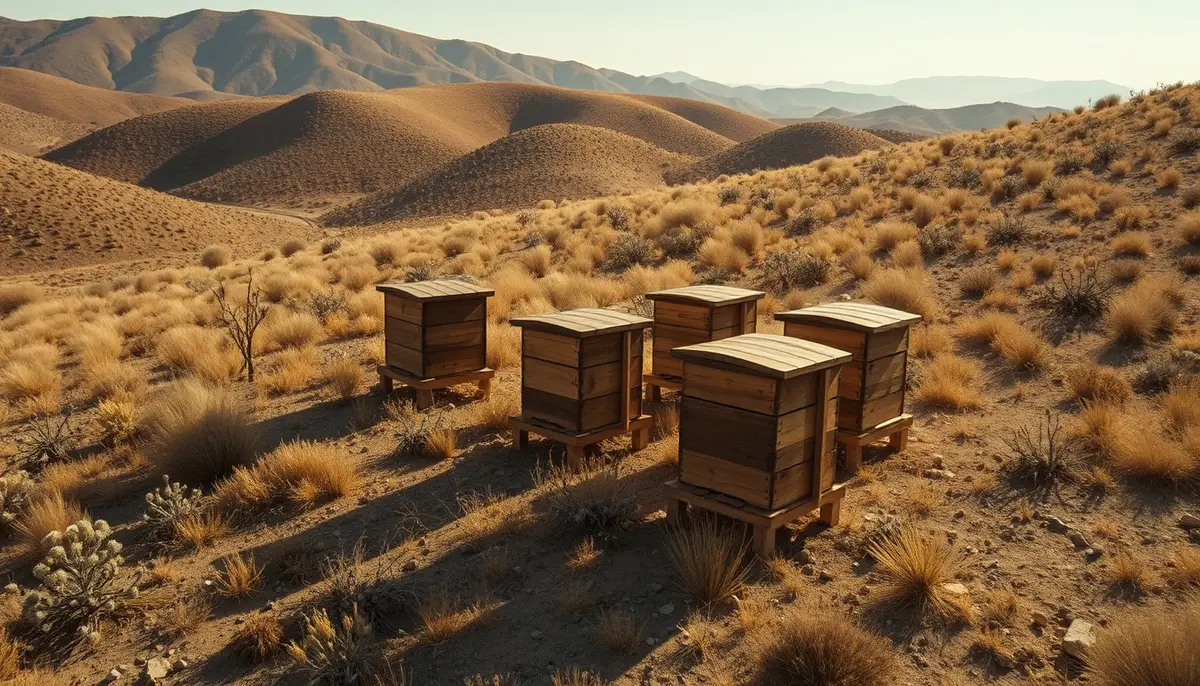
Beehives in drought-stressed California sage scrub landscape
Data Story · Climate Risk

Honey Supply Risk Index

Which varieties will climate change make scarce — and which are already priced for it?

Not all honey is equally vulnerable to a changing climate. Tupelo honey grows in one river basin in Florida. Sage honey grows in one state’s coastal chaparral. Both score at the top of this index. Meanwhile, manuka honey averages $58 a listing in our catalogue despite having lower supply risk than heather, sourwood, or blueberry honey.

The Honey Supply Risk Index scores 16 varieties across three factors to answer a simple question: which honeys should you buy while you still can, and which are safe staples?

Methodology note: Average prices are the mean listing price (midpoint of each listing’s price range) per floral source across the 304 honeys in our catalogue, each checked against a live product page on October 7, 2026. Listings cover different jar sizes, so these are not prices per ounce. Risk scores draw on White (1975), Persano Oddo & Piro (2004) and USDA Honey Market Reports 2019–2024. See methodology for full source documentation.

The Three-Factor Framework

Each variety is scored on three dimensions. Climate Threat is weighted most heavily (2.5×) because it is the direction of travel — even a geographically distributed variety can face concentrated risk if its ecosystem type is globally threatened.

G2.0×
Geographic Concentration
How many independent production regions supply this variety? Score 5 = one watershed; 1 = temperate zones globally.
W1.5×
Harvest Window Risk
How narrow and weather-dependent is the bloom window? Score 5 = ≤2 weeks with special access conditions; 1 = 6–8 week season.
C2.5×
Climate Threat Score
Severity of the primary climate driver threatening this ecosystem: drought, flood, wildfire, frost timing, disease, or phenological mismatch.
Risk Index = (G × 2 + W × 1.5 + C × 2.5) / 30 × 100

Risk Rankings — All 16 Varieties

Sorted highest to lowest composite risk score.

100
Critical
95
Critical
88
Critical
80
Critical
80
Critical
68
High
63
High
57
Moderate
53
Moderate
53
Moderate
52
Moderate
48
Moderate
38
Low
28
Low
Critical (≥80)High (60–79)Moderate (40–59)Low (<40)

Risk Map: Concentration vs. Climate Threat

Each bubble is one floral source; size = number of catalogue listings. Upper-right quadrant = highest combined risk.

Critical ZoneSafe Zone12345Geographic Concentration →12345Climate Threat →TupeloSageAvocadoSourwoodBlueberryOrange BlossomHeatherLindenEucalyptusLavenderChestnutManukaBuckwheatAcaciaCloverWildflower

Bubble size ∝ number of catalogue listings. Jitter applied where two varieties share identical G/C values.

Critical Zone: 5 Varieties in Jeopardy

Tupelo
Apalachicola River, FL
100
G: 5/5W: 5/5C: 5/5Avg $25/listing

Sea-level rise + altered swamp hydrology

Sage
California coastal chaparral
95
G: 5/5W: 4/5C: 5/5Avg $19/listing

Megadrought + megafire destroying chaparral

Avocado
California & Hawaii
88
G: 4/5W: 4/5C: 5/5Avg $15/listing

California water scarcity — groves abandoned

Sourwood
Appalachian ridge, NC/TN/GA
80
G: 4/5W: 4/5C: 4/5Avg $19/listing

Erratic spring frost + summer Appalachian drought

Blueberry
Maine, NJ, MI, Pacific NW
80
G: 4/5W: 4/5C: 4/5Avg $13/listing

Bloom–bee synchrony breakdown as spring warms unevenly

Why sourwood and blueberry honey both score 80: They share the same G=4, W=4, C=4 profile via different mechanisms — sourwood is geographically anchored to the Appalachian ridge and threatened by erratic spring frosts; blueberry honey suffers phenological mismatch as warming decouples bee emergence from bloom timing.

Risk vs. Average Listing Price

If supply risk set prices, the most climate-vulnerable honeys would be the most expensive. In our catalogue they are not: 2 of the 5 critical-risk varieties average less than the catalogue’s non-Manuka mean of $18.27 a listing, and the most expensive variety, Manuka, scores moderate risk. Listing prices mix jar sizes, so treat small gaps as noise.

Critical risk, below the $18.27 average
AvocadoScore 88 · $15.05/listing · n=8

California water scarcity — groves abandoned

BlueberryScore 80 · $13.32/listing · n=7

Bloom–bee synchrony breakdown as spring warms unevenly

Critical risk, at or above the $18.27 average
TupeloScore 100 · $25.30/listing · n=8

Sea-level rise + altered swamp hydrology

SageScore 95 · $18.53/listing · n=7

Megadrought + megafire destroying chaparral

SourwoodScore 80 · $18.86/listing · n=12

Erratic spring frost + summer Appalachian drought

Moderate risk, highest price
ManukaScore 52 · $58.38/listing · n=17

Manuka honey scores moderate risk (52/100) — New Zealand is actively scaling cultivation and the shrub is hardy. In our catalogue its price tracks the MGO grade printed on the jar (see the MGO price curve), not supply risk. Heather honey ($15.28/listing, score 68) and sourwood ($18.86/listing, score 80) are both more climate-vulnerable and cheaper.

Full Index — All 16 Varieties

VarietyGWCScoreAvg Price
Tupelo
Apalachicola River, FL
555100$25
Sage
California coastal chaparral
54595$19
Avocado
California & Hawaii
44588$15
Sourwood
Appalachian ridge, NC/TN/GA
44480$19
Blueberry
Maine, NJ, MI, Pacific NW
44480$13
Orange Blossom
FL, CA, Spain, Mexico
34473$19
Heather
Scotland, Ireland, N. Europe
33468$15
Linden
Central & Eastern Europe
25363$11
Eucalyptus
Australia, CA, Spain
22457$16
Lavender
Provence, Spain, Tuscany
23353$15
Chestnut
Italy, France, Spain
23353$24
Manuka
New Zealand, SE Australia
33252$58
Buckwheat
NY, PA, MN, Canada, Europe
22348$16
Acacia
Eastern & Central Europe
13238$15
Clover
Temperate zones globally
11228$13
Wildflower
Everywhere temperate
11120$19

G = Geographic Concentration · W = Harvest Window Risk · C = Climate Threat · Score = (G×2 + W×1.5 + C×2.5) / 30 × 100

Resilient Staples: The Safe Harbors

Three varieties score below 40 — genuinely resilient across all three dimensions.

Eastern & Central Europe

Late-frost risk; Robinia is drought-hardy and expanding

Temperate zones globally

Pesticide pressure; plant itself highly resilient

Everywhere temperate

Botanical diversity is the hedge — single-variety failures masked

Wildflower honey’s resilience is structural, not accidental. A wildflower honey jar contains pollen from dozens of species across an entire season. When one plant fails, others compensate — botanical diversity is the hedge. This is the same logic behind multi-factor financial portfolios and polyculture farming. By contrast, specialty varieties like tupelo or sage honey depend entirely on single botanical sources.

Practical Pantry Strategy

Buy a jar while you can
TupeloSageSourwoodAvocado

These will become harder to source and more expensive. Buy from small US producers — they're transparent about harvest conditions and you'll know when seasons are poor.

Worth monitoring closely
BlueberryOrange BlossomHeatherLinden

High risk but not yet in crisis. Follow producers in these regions — a poor season is now meaningful news, not a routine weather complaint.

Buy for taste, not urgency
ManukaLavenderChestnutBuckwheat

Moderate risk, manageable supply. Don't overpay for manuka's MGO marketing — there are cheaper high-quality options in this tier.

Safe staples — stock freely
CloverWildflowerAcacia

Low supply risk, globally sourced. These are your everyday cooking honeys — buy the best quality you can afford but don't worry about stockpiling.

Frequently Asked Questions

Which honey is most at risk from climate change?▾
Tupelo honey scores 100/100 on the Honey Supply Risk Index — it comes from a single river basin (the Apalachicola River in Florida), requires precisely timed swamp flooding for barge access, and faces existential pressure from sea-level rise and altered hydrology. Sage honey (California chaparral) scores 95/100 due to compounding megadrought and megafire risk to the coastal sage ecosystem.
Why is manuka honey so expensive if its supply risk is moderate?▾
Manuka honey scores 52/100 — moderate, not critical. New Zealand is actively scaling manuka cultivation; the shrub is hardy and not geographically endangered. In our catalogue Manuka listings average $58.38, and the price tracks the MGO grade printed on the jar rather than supply risk. By contrast, sage honey ($18.53 average) scores 95/100.
Why is tupelo honey the highest-risk variety?▾
Three factors combine at maximum severity. Geographic concentration: all commercial tupelo honey comes from a ~100-mile stretch of the Apalachicola River in Florida — no substitutable production region exists. Harvest window: bees must access white tupelo blossoms by boat during a precise 2-week water-level window; any deviation eliminates the harvest. Climate threat: sea-level rise, altered Gulf storm patterns, and changed freshwater inflows directly threaten the Ogeechee tupelo (Nyssa ogeche) swamp ecosystem.
Is sage honey really more climate-vulnerable than manuka?▾
Yes. California white sage (Salvia apiana) producing sage honey grows exclusively in coastal chaparral — an ecosystem undergoing rapid contraction due to compounding drought, megafire, and development pressure. The 2020–2022 California fire seasons burned large sections of productive sage territory. Manuka (Leptospermum scoparium) grows across New Zealand and southeast Australia, is being actively cultivated, and has no equivalent ecosystem-level threat. Sage honey scores 95/100; manuka scores 52/100.
What does "geographic concentration" mean for honey supply risk?▾
Geographic concentration measures how many independent production regions supply a variety. A score of 5 (most concentrated) means one watershed, one mountain range, or one state — a single weather event can wipe the entire annual crop. A score of 1 (least concentrated) means the variety is produced across temperate zones globally, so regional failures don't threaten total supply. Tupelo honey (one river) and sage honey (one state's coastal range) both score 5.
Will clover and wildflower honey always be available?▾
Clover honey and wildflower honey score 28 and 20 respectively — the lowest risk scores in the index. Wildflower honey's botanical diversity is its hedge: when one plant fails, others compensate. Clover is grown globally across temperate climates and is a resilient weed. The main risk to clover honey (pesticide pressure, neonicotinoids) is serious but doesn't threaten the variety at a systemic level the way climate does for geographically concentrated honeys.
How was the Honey Supply Risk Index calculated?▾
Three factors were scored 1–5: Geographic Concentration (G, weight 2.0), Harvest Window Risk (W, weight 1.5), and Climate Threat Score (C, weight 2.5). Composite = (G×2 + W×1.5 + C×2.5) / 30 × 100. Climate threat is weighted most heavily because it represents the direction of travel — even a geographically distributed variety can face concentrated risk if its ecosystem type is globally threatened. Data sources include USDA honey market reports, Koetz et al. (2022) Apidologie climate review, Potts et al. (2010) Science, USFS wildfire data, and Apalachicola River Basin hydrological studies. See /learn/methodology for full source documentation.
Should I buy extra tupelo or sourwood honey now before prices rise?▾
Buying a jar or two of high-risk varieties like tupelo, sage, or sourwood honey you love makes sense as pantry strategy. But industrial-scale stockpiling isn't warranted — most honeys last 1–2 years at room temperature and indefinitely when sealed and stored properly. The more useful response is to learn what you enjoy, buy from small US producers (they're more transparent about harvest conditions), and monitor when producers report poor seasons. Meanwhile, reliable varieties like clover and wildflower honey remain excellent daily staples. The risk index is a structural-trend signal, not a 1-year price prediction.
RHG

Edited by Sam French · Raw Honey Guide Editorial Team

Source reviewed against primary literature and official guidance where available. Health content is educational, not medical advice, and does not replace a licensed clinician.

Source reviewedHealth disclaimerEditorial Policy ↗